
OES spectrometer: laboratory, mobile or handheld?
The criteria that determine the right choice of metal analyser for your business.
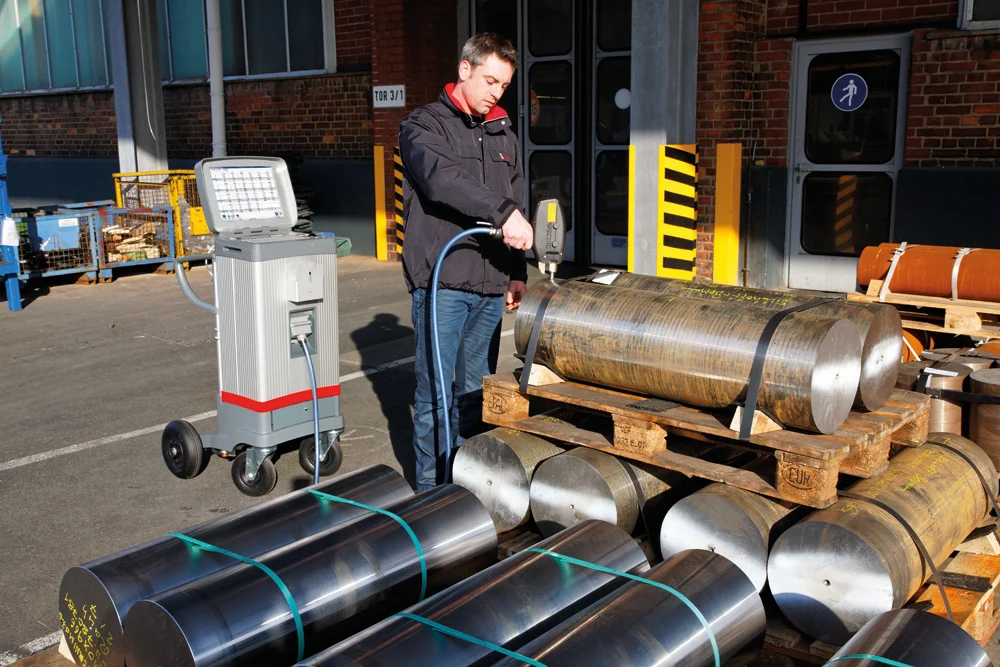
A stationary spectrometer in the laboratory, a mobile system that goes to the material, or a handheld analyser for fast sorting? All three analyse metals, but they meet different needs. Below we have gathered the criteria that, based on our experience in Greek industry since 1998, determine the right choice.
The three categories at a glance
- Stationary (laboratory) OES spectrometers – e.g. SPECTROLAB S, SPECTROMAXx, SPECTROCHECK. Installed in the quality control laboratory, they analyse the samples you bring to them.
- Mobile OES spectrometers on wheels – e.g. SPECTROTEST, SPECTROPORT, SPECTROPORT LIBS. Moved to the warehouse, the production line or the plant, they analyse the part where it is.
- Handheld XRF analysers – e.g. SPECTRO xSORT. Small and lightweight, for fast, non-destructive alloy identification and sorting.
1. Which elements do you need to measure?
This is usually the most decisive question. Stationary OES spectrometers accurately determine even the most difficult elements, such as traces of carbon, phosphorus, sulphur and nitrogen, as well as trace elements and impurities at very low concentrations. They are the solution when you need a complete chemical analysis for a certificate or for production control.
The mobile OES spectrometers on wheels with a spark source also analyse elements such as carbon, sulphur, phosphorus and boron, so they can distinguish, for example, low-carbon steels (e.g. “L” stainless grades) – something an XRF analyser cannot do.
The XRF analysers measure most alloying elements (e.g. Cr, Ni, Mo, Cu, Zn) very quickly, but do not measure carbon and have limitations with light elements. They are ideal for sorting and identification, not for complete steel analysis.
2. Where is the material?
If you can take a sample and bring it to the laboratory – as in foundries, steelworks and alloy plants – a stationary spectrometer offers the best accuracy and stability. But when the material is large, heavy or already installed (pipes, tanks, valves, bars in the warehouse), the mobile system goes to where the part is. A handheld analyser reaches even hard-to-access spots and scrap piles.
3. Accuracy or speed?
A stationary spectrometer gives the most accurate and repeatable results, but requires sampling and preparation. A mobile OES offers reliable analysis in the field, suitable for incoming material inspection and positive material identification (PMI). An XRF analyser gives a result in a few seconds, without leaving a mark on the material – ideal when you need to check large numbers of parts.
4. Sample preparation
Spark OES analysis requires a clean, flat metal surface. In the laboratory this is done by grinding or milling the sample – correct sample preparation directly affects accuracy. Mobile OES instruments also need a short cleaning of the measuring spot and leave a small spark mark. An XRF analyser is non-destructive, although a clean surface always improves the result.
5. Purchase and running costs
Beyond the purchase price, take into account consumables (e.g. argon for spark spectrometers), periodic calibration with certified reference materials, maintenance and technical support. For businesses with a smaller number of analyses, an economical stationary spectrometer such as the SPECTROCHECK or an inspected used instrument may be the most sensible investment.
Comparison table
| Stationary OES | Mobile OES | Handheld XRF | |
|---|---|---|---|
| Where it is used | Laboratory | Warehouse, production, plants | Anywhere, even hard-to-reach spots |
| Carbon (C) | Yes, even in traces | Yes | No |
| Accuracy | The highest | High | Good for identification |
| Speed | Minutes (including preparation) | Seconds to a few minutes | A few seconds |
| Sample | Grinding / milling of the sample | Short cleaning of the spot | Minimal, non-destructive |
| Typical use | Production control, certificates | Incoming inspection, PMI | Scrap sorting, identification |
Often the answer is a combination
Many of our customers use a stationary spectrometer in the laboratory for production control and a portable analyser to check raw materials and scrap at the gate. The key is to start from your real needs: which materials you analyse, which elements matter to you, how many analyses you run per day and where the material is.
