
Spark OES or XRF? Two techniques, different roles
How each one works, what it measures and when you need it.
Spark optical emission spectrometry (Spark OES) and X-ray fluorescence (XRF) are the two most widely used techniques for the chemical analysis of metals. They are often compared as if they were competitors, but in practice they answer different questions. Let’s look at the differences in simple terms.
How Spark OES works
In emission spectrometry, an electric spark in an argon atmosphere vaporises a small amount of material from the sample surface. The atoms are excited and emit light at wavelengths characteristic of each element. The spectrometer’s optical system analyses this light and calculates the concentration of each element.
The big advantage of the technique is that it also accurately measures light elements such as carbon, phosphorus, sulphur, boron and nitrogen, at very low concentrations. That is why it is the reference tool in steelworks, foundries and aluminium and copper production. Examples are the stationary spectrometers SPECTROLAB S and SPECTROMAXx and the mobile SPECTROPORT.
How XRF works
In XRF, an X-ray tube irradiates the sample and the atoms emit secondary (fluorescent) radiation, also characteristic of each element. A detector measures this radiation and the instrument calculates the composition.
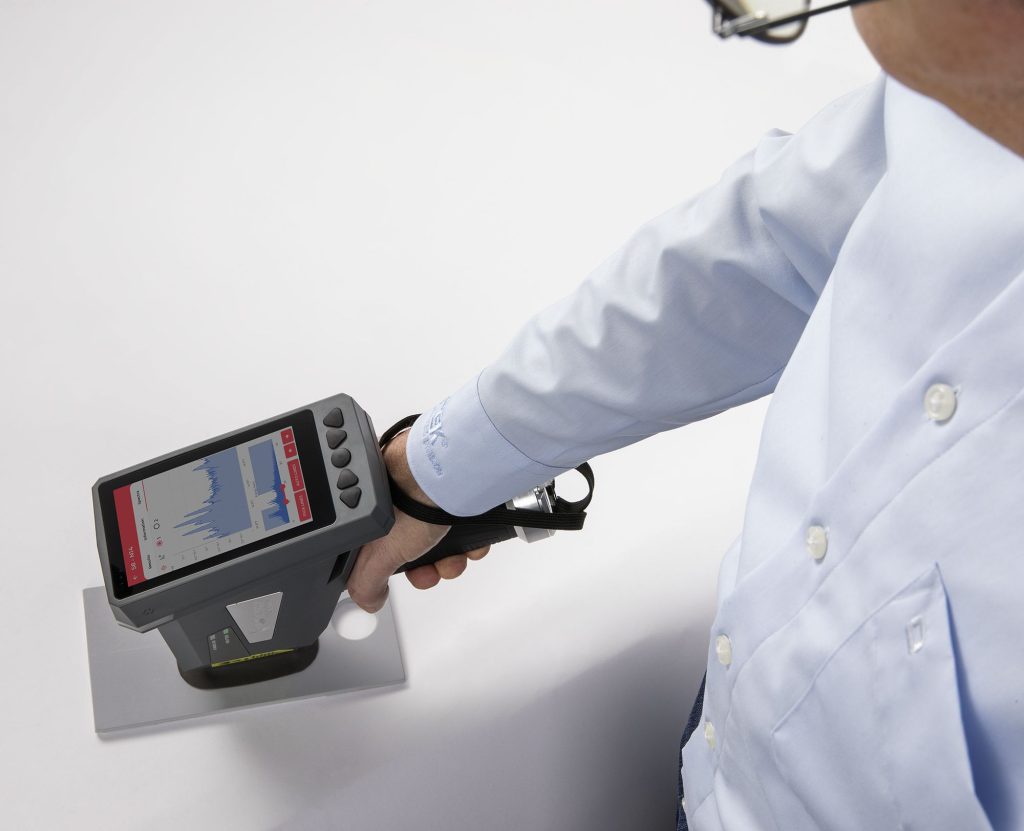
The measurement is non-destructive, takes a few seconds and usually requires no sample preparation. The physical limitation of the technique is that it does not measure carbon or the very light elements. Handheld analysers, such as the SPECTRO xSORT, are ideal for alloy sorting, incoming material inspection and grade identification.
Comparison table
| Spark OES | XRF | |
|---|---|---|
| Measuring principle | Light emission after spark excitation | Fluorescence after X-ray irradiation |
| Carbon and light elements | Yes (C, P, S, B, N) | No |
| Low concentrations | Excellent sensitivity, ppm level | Good for most alloying elements |
| Sample preparation | Grinding or milling of the surface | Usually none |
| Effect on the sample | Small burn mark | Non-destructive |
| Consumables | Argon | Minimal |
| Typical use | Production control, certification, PMI with carbon | Alloy sorting, scrap, incoming inspection |
When to choose each one
Choose Spark OES when you need a complete chemical analysis for certification, when carbon is critical (e.g. distinguishing L from H grades, such as 304 from 304L) or when you control production in a foundry or steelworks.
Choose XRF when speed and ease of use matter most: sorting large quantities of scrap, checking materials in the warehouse, measuring finished parts that must not be marked.
See all the OES spectrometers we offer in detail.
Often you need both
In many businesses the two techniques work together: XRF does the fast sorting and the OES spectrometer the final, complete analysis. To look at the options in detail, read our spectrometer selection guide.
