
PMT, CCD or CMOS? The detector makes the difference
How the three detector technologies in spark spectrometers work and what they mean for detection limits, flexibility and stability.
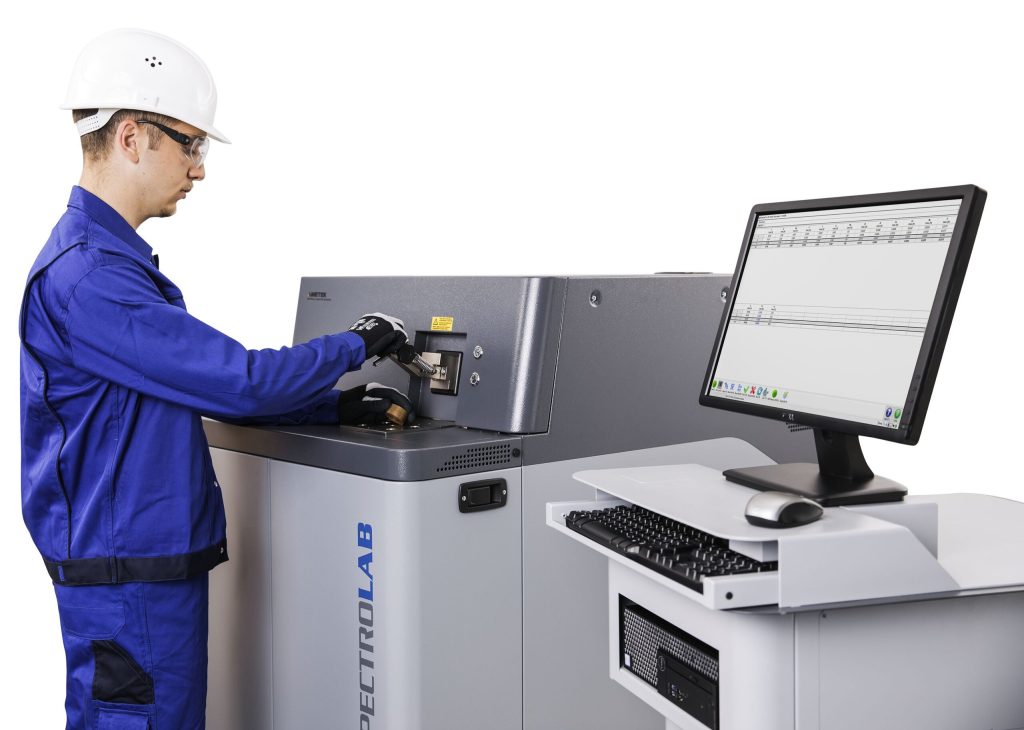
When comparing spark emission spectrometers, we usually look at the elements they measure, the detection limits and the speed. Behind all this, however, is a component that is rarely discussed: the detector, the “eye” of the instrument that converts the light of the spark into a measurable signal. In this article we explain in simple terms the three technologies – PMT, CCD and CMOS – and what each one means in practice.
Why the detector matters so much
In spark emission spectrometry, the spark vaporises and excites a small amount of the sample, which emits light. The optical system splits this light into its wavelengths and the detector measures the intensity of each spectral line. The range relevant to metal analysis extends roughly from 120 to 780 nm, and iron alone has more than 4,000 emission lines. Which of these lines the detector can “see”, with what sensitivity and how stably, largely determines the capabilities of the instrument.
PMT: the photomultiplier, the classic solution
The photomultiplier tube (PMT) is an evacuated glass tube with a photocathode, operating at voltages of up to about 1,200 V. For decades it was the reference technology in high-end spectrometers, thanks to its high gain, low noise and wide dynamic range, which favour the measurement of trace elements.
Its main limitation is that each PMT measures only one spectral line, through its own exit slit. A PMT instrument is configured at the factory for specific elements, typically up to about 80 lines. Adding a new element requires hardware changes, recalibration and usually a technician visit. In addition, every tube is unique, with its own cost and behaviour. If a PMT fails, the corresponding line is lost, and without temperature stabilisation the results are affected by changes in the environment.
CCD: the whole spectrum on one sensor
CCD (charge-coupled device) sensors are silicon semiconductors with thousands of pixels in a row. They were invented in 1969 and started being used in spark spectrometers in the late 1990s. Instead of one line per detector, a CCD records a continuous section of the spectrum, so the instrument has access to many more lines.
Their advantages are high resolution, durability, uniform sensitivity and low noise, flexibility in adding elements and lower cost. That is why for many years CCDs dominated portable spectrometers and stationary instruments for foundries and mid-sized companies, such as earlier generations of the SPECTROMAXx. Their limitation is that they do not support time-resolved measurement of the spark (see below), which is why they historically lagged behind PMTs in very low detection limits and inclusion identification.
CMOS: the new generation
CMOS (complementary metal oxide semiconductor) sensors are also semiconductors, but they integrate analogue-to-digital conversion and noise reduction on the same chip. The result is a wider dynamic range and faster data throughput than CCDs, with every pixel more reproducible than an individual PMT.
Today SPECTRO uses CMOS sensors in all of its stationary spectrometers: the SPECTROLAB S, the SPECTROMAXx and the SPECTROCHECK. In the SPECTROLAB S the technology evolves into CMOS+T, which combines coverage of the entire spectrum with time-resolved measurement. So, for the first time, a semiconductor detector offers capabilities that until recently only PMT instruments had.
Same sensor, different optical system
The sensor is only one part of the equation. Equally important is the optical system, which splits the light of the spark before it reaches the sensor. The longer the optical system, the more the spectrum is “spread out”. Lines that are very close to each other are therefore better separated, spectral interferences are reduced and detection limits improve.
That is why SPECTRO’s three stationary instruments, although they all use CMOS sensors, address different needs:
- SPECTROLAB S: the largest optical system, with CMOS+T technology, for the highest requirements.
- SPECTROMAXx: two optical systems, shorter than that of the SPECTROLAB S, for a wide range of production control applications.
- SPECTROCHECK: one optical system, the most compact of the three, as an economical solution for routine analyses.
Time-resolved spectroscopy and single spark evaluation
Two techniques make the difference in demanding analyses:
- Time-resolved spectroscopy (TRS): measures the emission in successive time segments of each spark. Because the useful signal and the background peak at different moments, this technique reduces noise and inter-element effects and improves detection limits.
- Single spark evaluation (SSE): evaluates each spark separately in order to detect inclusions, for example manganese sulphide (MnS) in steel.
PMTs support both techniques, but only for the lines installed. CCDs do not support them. CMOS+T technology applies them across the entire spectrum.
Comparison table
| PMT | CCD | CMOS (CMOS+T) | |
|---|---|---|---|
| Type | Vacuum tube | Silicon semiconductor | Semiconductor with integrated electronics |
| Spectral coverage | One line per tube | Continuous spectrum | Continuous spectrum |
| Adding elements | Hardware change and recalibration | By software | By software |
| Time-resolved measurement (TRS/SSE) | Yes, only on installed lines | No | Yes, across the whole spectrum |
| Detection limits | Very low | Low | Equal to or lower than PMT* |
| If a line is “lost” | The measurement is lost | Alternative line | Alternative line |
| Where you find it | Older high-end instruments | Previous generation of stationary instruments, portable units | Modern stationary instruments; CMOS+T in high-end models |
* According to the manufacturer’s data below.
What the detection limits show
SPECTRO’s white paper “PMT vs. CMOS: The Paradigm Shift in Metal Analyzer Detector Technologies” (2019) presents comparative detection limits (in ppm) between a PMT instrument and the SPECTROLAB S with CMOS+T. For example:
| Element | Base | PMT (ppm) | CMOS+T (ppm) |
|---|---|---|---|
| Lead (Pb) | Iron | 3,5 | 1,9 |
| Selenium (Se) | Iron | 15 | 2,5 |
| Copper (Cu) | Iron | 6,7 | 2,4 |
| Arsenic (As) | Iron | 3,6 | 1,6 |
| Silver (Ag) | Iron | 0,4 | 0,1 |
| Copper (Cu) | Aluminium | 8,3 | 1 |
| Lead (Pb) | Aluminium | 1 | 0,3 |
| Boron (B) | Aluminium | 0,5 | 0,2 |
| Cerium (Ce) | Aluminium | 4,5 | 1 |
These are manufacturer’s values obtained under specific measurement conditions. In practice, detection limits also depend on the alloy base, sample preparation and calibration with certified reference materials.
Flexibility, speed and stability
Because a CMOS detector “sees” the entire spectrum, the instrument can use several lines per element and choose the optimum combination of analytical and reference line. In one SPECTROLAB S installation reported by SPECTRO, 170 analytical lines are used to measure 59 elements. New elements or applications can be added later with a software update.
According to the manufacturer, the SPECTROLAB S delivers results for low-alloy steels in under 20 seconds, while the iCAL 2.0 software continuously corrects drift caused by temperature and needs only one sample to standardise the instrument.
Which instrument suits you
- Routine analyses and smaller sample volumes: the SPECTROCHECK offers CMOS technology in an economical form.
- Foundries, manufacturing and mid-sized companies: the SPECTROMAXx, with its two optical systems, comfortably covers production control and common specifications.
- Steelworks, aluminium and copper production, high-end laboratories: when trace elements, very low detection limits, inclusions and many different alloy bases matter, the SPECTROLAB S with CMOS+T is the most complete solution.
- Existing PMT or CCD instruments: many work reliably for years. But if you need new elements or applications, lower detection limits, or if maintenance becomes costly, it is worth considering an upgrade.
See all the OES spectrometers we offer in detail.
For an overview of all the options, read our spectrometer selection guide.
