
Methods for the chemical analysis of metals OES, XRF, LIBS, ICP and combustion analysis
The main techniques for the chemical analysis of metals and alloys: what each one measures, where it excels and how to choose the right one for your application.
Chemical analysis tells you exactly what a metal or alloy is made of. It decides whether a material meets its specification, whether a casting will turn out right and whether a load of scrap is sold at the right price. But no single method does everything: each technique has its own strengths and limits.
Why chemical analysis of metals is needed
The properties of an alloy, such as strength, weldability and corrosion resistance, are determined by its chemical composition. Small deviations, for example a few hundredths of a percent more carbon or sulphur, can change how the material behaves. That is why analysis is carried out at every stage: on receipt of raw materials, in the melt before casting, on the final product and for material identification in plants.
Spark optical emission spectrometry (Spark OES)
An electric spark in an argon atmosphere vaporises a small amount of material from the sample surface. The excited atoms emit light at characteristic wavelengths, and the spectrometer measures the intensity of each line to calculate the concentration of each element.
Advantages: complete analysis in less than a minute, very low detection limits and accurate measurement of elements such as carbon, phosphorus, sulphur, boron and nitrogen. It is the established control method in metallurgy, with international standards such as ASTM E415 for carbon and low-alloy steels.
Limitations: it needs a flat, clean metal surface and leaves a small mark on the sample. It cannot analyse non-conductive materials such as oxides or slags.
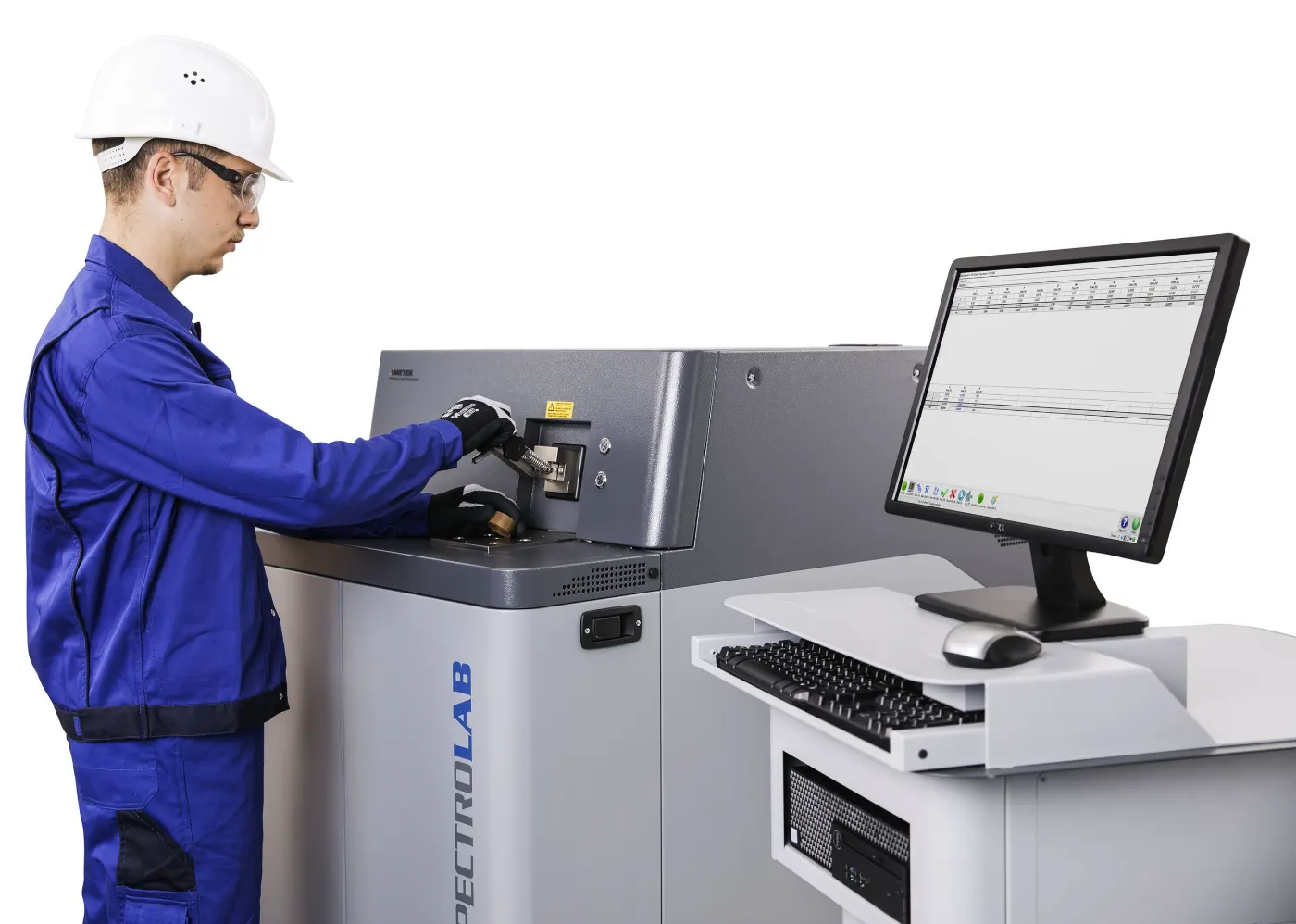
The laboratory uses stationary spectrometers such as the SPECTROLAB S, the SPECTROMAXx and the SPECTROCHECK. For on-site measurements there are the mobile SPECTROTEST and SPECTROPORT. See all our OES spectrometers.
X-ray fluorescence (XRF)
X-rays excite the atoms of the sample, which emit secondary radiation (fluorescence) with an energy characteristic of each element. Handheld XRF analysers give a result in a few seconds without altering the material, while laboratory XRF systems also analyse non-metallic materials such as oxides, slags and ores.
Advantages: non-destructive, very fast, with little or no preparation for alloy sorting.
Limitations: it does not measure carbon and has limited sensitivity to light elements. It only measures the surface, so coatings, paint or oxidation affect the result. For alloy sorting, see the SPECTRO xSORT and the comparison Spark OES or XRF.
LIBS spectroscopy
In laser-induced breakdown spectroscopy (LIBS), a laser pulse creates a microscopic plasma on the sample surface, and its light is analysed as in OES. The mark it leaves is almost invisible.
Advantages: very fast measurement and good response to light elements such as magnesium, silicon, lithium and beryllium. This makes it particularly useful for sorting aluminium alloys in recycling. Unlike XRF, it also measures carbon, which helps to distinguish L-grade stainless steels or steels with different carbon contents.
Limitations: accuracy and detection limits, especially for carbon, do not match those of a spark spectrometer, and the result is affected by the condition of the surface. See the SPECTROPORT LIBS.
ICP-OES and ICP-MS
In inductively coupled plasma (ICP) techniques, the sample is first dissolved in acids and the solution is introduced into an argon plasma. ICP-OES measures the emitted light, while ICP-MS measures the ions directly with a mass spectrometer.
Advantages: extremely low detection limits, especially with ICP-MS, and simultaneous analysis of many elements in all kinds of samples, not only metals.
Limitations: dissolving the sample is time-consuming and requires specialised staff and a chemical laboratory. It is not suitable for fast production control and is not used to measure carbon.
Combustion and inert gas fusion analysis
For carbon and sulphur, the sample is burned in a stream of oxygen and the resulting gases are measured by infrared absorption. For oxygen, nitrogen and hydrogen, the sample is melted in a furnace under inert gas. These methods are described in standards such as ASTM E1019.
Advantages: very high accuracy for C and S, even at very low or very high concentrations, and measurement of gases (O, N, H) that cannot be reliably determined with a spark.
Limitations: it measures only these few elements, so it usually complements an OES spectrometer rather than replacing it.
Classical wet chemical analysis
Classical methods such as titration, gravimetric analysis and atomic absorption spectrophotometry (AAS) were the norm for decades. Today they are used mainly as reference methods or for special cases, because they are slow and labour-intensive.
Comparison table
| Spark OES | XRF | LIBS | ICP-OES / MS | Combustion / fusion | |
|---|---|---|---|---|---|
| Sample form | Solid metal | Solid, powder | Solid | Solution | Chips, pieces |
| Carbon | Yes, accurately | No | Yes, with lower accuracy | No | Yes, very accurately |
| Detection limits | Very low (ppm) | Moderate | Moderate | Extremely low (ppb) | Very low |
| Analysis time | Seconds | Seconds | Seconds | Hours including preparation | 1–3 minutes |
| Sample damage | Small mark | None | Minimal | Destructive | Destructive |
| Typical use | Production control, laboratory, PMI | Sorting, PMI, oxides | Scrap sorting, light alloys | Trace elements, research | C, S, O, N, H |
Which method to choose
Production control in a steelworks, foundry or alloy plant: the spark spectrometer is the main choice, because it delivers a complete analysis, including carbon, in a few seconds.
Positive material identification (PMI) in plants: XRF when no mark is allowed and carbon is not needed; a mobile OES spectrometer when an accurate carbon measurement is required, for example for L-grade stainless steels. LIBS also measures carbon, but with lower accuracy than spark.
Scrap sorting: XRF or LIBS for fast sorting, with an OES spectrometer for loads that need a complete analysis.
Trace elements at very low concentrations or non-metallic samples: ICP-OES or ICP-MS.
In practice, many laboratories combine techniques. Whatever you choose, the reliability of the results depends on correct sample preparation and regular checks with certified reference materials (CRM). For the criteria for choosing an instrument, read our spectrometer selection guide.
Frequently asked questions
What is the most accurate method for analysing metals?
It depends on what you measure. For the complete composition of an alloy, the laboratory spark spectrometer combines accuracy and speed. For trace elements at ppb level ICP-MS excels, and for carbon, sulphur and gases, combustion and fusion analysis.
Can an XRF analyser measure carbon?
No. Carbon is too light an element for the XRF technique. If you need carbon, the right solution is an OES spectrometer or a combustion analyser. LIBS analysers also measure carbon, but with lower accuracy than spark.
Is analysis with an OES spectrometer destructive?
It leaves a small mark of a few millimetres on the surface, which is acceptable for many parts. For materials that must not be marked, XRF is preferred.
